-
Home
- NEW
- CZ Jewelry Collection
- Pearl Jewelry
- Minimalist Jewelry
- Natural Stone Jewelry
- Resin & Acrylic Jewelry
- Earrings
- Ring
- Necklace
How to Source Wholesale Stainless Steel Earrings from China
Oct 26, 2026Wholesale stainless steel earrings are an important product category for jewelry brands, wholesalers, distributors, retailers, and private-label businesses. Successful sourcing requires more than selecting attractive designs or comparing unit prices. Buyers need to evaluate material specifications, surface finishes, earring components, sample quality, production consistency, and supplier capabilities before placing a bulk order.
When sourcing from China, a reliable OEM jewelry manufacturer should be able to clarify product specifications, support sample evaluation, explain customization options, and establish quality control requirements before production begins.
This guide explains how to select wholesale earring styles, compare 304 and 316L stainless steel, evaluate PVD gold plating, inspect samples, and prepare for bulk production. It also outlines the key questions buyers should ask when choosing a stainless steel earring supplier for long-term B2B cooperation.
1. Choose Earring Styles for Your Target Market
The first step in wholesale earring sourcing is building a product assortment that matches the target market, retail positioning, and expected price range. Rather than purchasing unrelated designs, buyers should select complementary styles that serve different customer preferences.
Hoop Earrings and Huggie Earrings
Hoop earrings are available in different diameters, widths, profiles, and finishes. Popular design directions include slim hoops, chunky hoops, oval hoops, sculptural shapes, and textured metal surfaces.
Huggie earrings are smaller hoops designed to sit close to the earlobe. Their compact proportions make them suitable for minimalist jewelry collections and everyday fashion accessories.
When evaluating these styles, buyers should inspect hinge alignment, clasp security, opening resistance, product weight, and wearing comfort. The closure mechanism is particularly important because a visually attractive earring may still be unsuitable for retail if it is difficult to operate or does not close securely.
Stud Earrings
Stud earrings include geometric shapes, polished metal designs, CZ-set styles, pearl earrings, and compact decorative forms.
For wholesale buyers, stud earrings can provide a foundation for everyday jewelry collections. Important specifications include decorative-element dimensions, post length, post thickness, attachment position, and backing compatibility.
For stone-set designs, buyers should also examine the setting structure, stone alignment, and visible signs of looseness or uneven finishing.
Drop Earrings and Statement Earrings
Drop earrings offer opportunities for movement, texture, and distinctive silhouettes. Common options include elongated geometric designs, curved metal forms, organic shapes, and styles incorporating CZ or pearls.
Statement earrings require additional attention to weight, balance, attachment points, and connecting components. Buyers should evaluate how the earrings hang when worn rather than judging quality only from a front-facing photograph.
Build a Balanced Wholesale Collection
A practical assortment can combine several product groups:
- Core styles: Simple hoops, huggies, and geometric studs for everyday wear.
- Fashion styles: Sculptural shapes, textured surfaces, and distinctive silhouettes.
- Decorative styles: CZ accents, pearl elements, and mixed-material designs.
- Coordinated styles: Earrings that complement matching necklaces, bracelets, and rings.
The final assortment should reflect customer preferences, retail price positioning, and the purchasing budget.
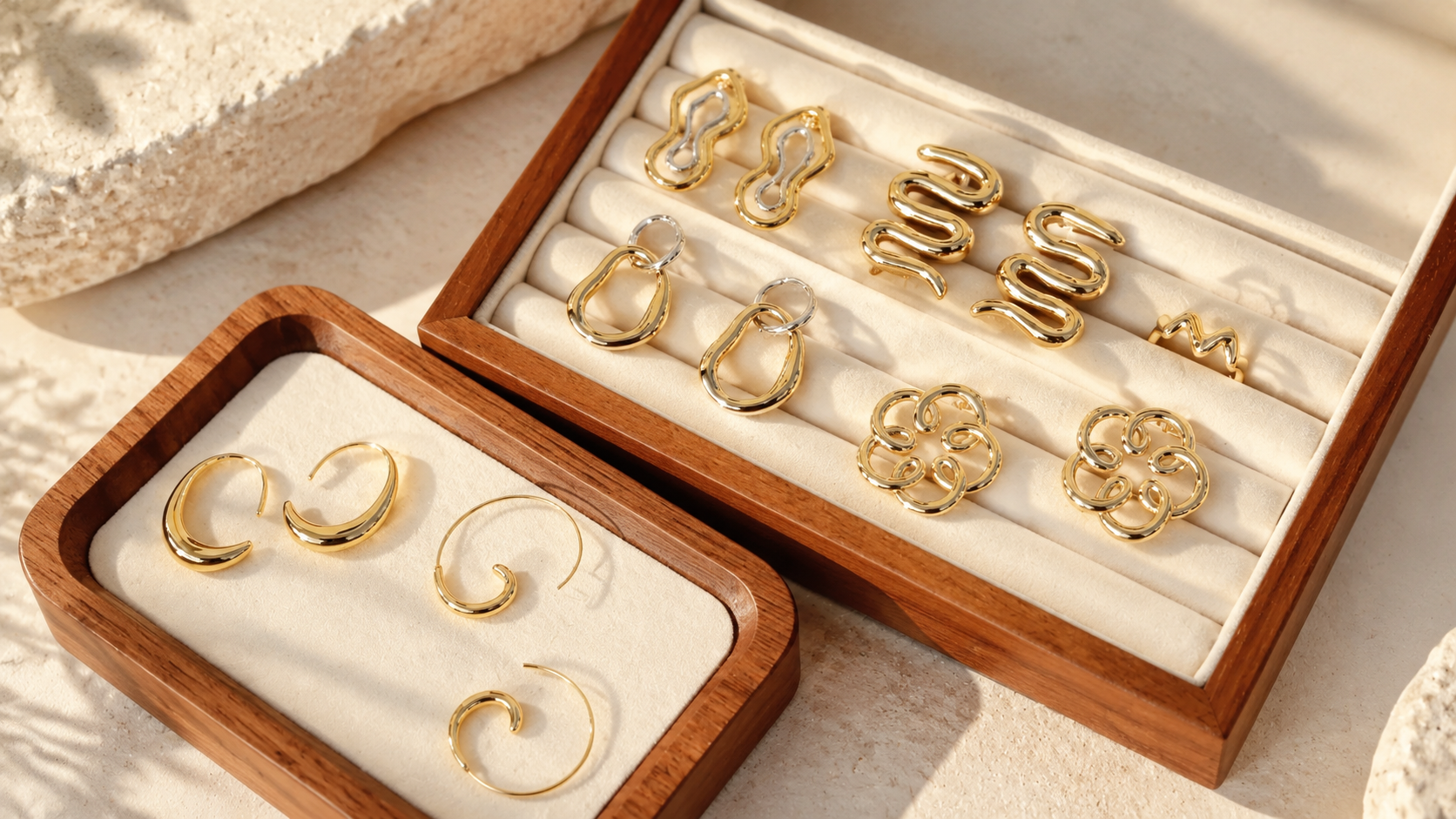
Explore the Touchlove Jewelry earrings collection to review available styles for wholesale sourcing and collection development.
2. Compare Stainless Steel Materials and Surface Finishes
Product specifications are essential when comparing stainless steel earring suppliers. Two earrings that look similar in photographs may differ in material grade, coating process, component construction, and manufacturing requirements.
304 vs. 316L Stainless Steel
304 and 316L stainless steel are used in jewelry applications, but their material properties differ.
Specification 304 Stainless Steel 316L Stainless Steel Material composition Chromium-nickel stainless steel Chromium-nickel-molybdenum stainless steel Common sourcing consideration General fashion jewelry applications Applications where improved corrosion resistance is a priority Key evaluation point Confirm the specified grade and suitability for the product Confirm the specified grade and suitability for the intended use Buyer documentation Request material specifications where required Request material specifications and relevant test documentation where required 316L contains molybdenum, which contributes to its improved corrosion resistance compared with 304 under many conditions. However, the appropriate material depends on the design, manufacturing process, intended use, and project requirements.
Buyers should confirm the actual material grade rather than relying on a supplier's general description. Material suitability should be assessed using verifiable specifications and, where appropriate, supporting documentation.
PVD Gold Plating and Other Finishes
Stainless steel earrings can be produced in gold-tone, rose gold-tone, black, natural steel-tone, polished, brushed, and textured finishes.
PVD (physical vapor deposition) is a surface-coating process used in many metal-finish applications. Buyers sourcing from a PVD gold plating supplier should confirm the specified coating process, desired color, surface appearance, and applicable quality requirements.
The term gold-tone describes the color of a product. It does not, by itself, mean the item is made from solid gold or contains a specified amount of real gold.
When evaluating samples, compare color consistency, surface smoothness, visible scratches, edge finishing, and the appearance of joints and recessed areas. Any coating durability expectations should be discussed and documented before bulk production.
Earring Posts, Backings, and Other Components
Small components can significantly affect product usability and customer satisfaction. Before approving a sample, buyers should confirm:
- Post specifications: Material, length, thickness, straightness, and attachment position.
- Backing compatibility: Fit, retention, ease of use, and compatibility with the specified post.
- Hinge and clasp construction: Alignment, opening resistance, and closure security.
- Connecting components: Attachment strength and alignment between decorative elements.
- Dimensions and weight: Overall proportions, thickness, and wearing comfort.
For buyers sourcing products marketed for sensitive ears, material composition and relevant nickel-release requirements should be verified against the intended market's applicable standards. The term hypoallergenic should not be treated as a universal guarantee that a product will cause no reaction.
3. How to Evaluate Earring Samples Before a Bulk Order
Sample evaluation helps buyers identify product issues before committing to larger quantities. A photograph cannot fully demonstrate component fit, clasp operation, surface quality, or manufacturing consistency.
A structured sample inspection should cover the product's appearance, functionality, dimensions, and agreed specifications.
Check Appearance and Pair Consistency
Inspect both earrings together under consistent lighting. Look for differences in shape, size, thickness, symmetry, color, polishing, and decorative details. On a pair of earrings, visible differences between the left and right pieces may affect the perceived quality of the finished product.
For textured or sculptural designs, check whether the main surface details match the approved reference. For CZ-set or pearl earrings, inspect decorative-element placement, alignment, and visible condition.
Inspect Posts and Backings
Check whether the posts are straight and securely attached. Insert and remove the backings several times to evaluate their fit and operation. The backing should be compatible with the specified post and provide the agreed level of retention. Excessively loose fittings, difficult assembly, or inconsistent component fit may cause problems during retail handling and customer use.
Test Hinges and Clasps
For hoops and huggies, open and close the mechanism repeatedly. Check that the hinge moves smoothly, the closure aligns correctly, and the clasp engages securely. Look for excessive movement, visible gaps, sharp edges, or parts that feel unstable during operation.
Examine Surface Quality and Stone Settings
Inspect polished surfaces for scratches, dents, uneven finishing, discoloration, and other visible defects. For coated products, compare the finish across both earrings and examine edges, joints, and recessed areas. Any coating durability tests should follow agreed specifications and appropriate test methods rather than relying solely on visual inspection.
For CZ-set earrings, check stone positioning and setting security. For pearl earrings, examine the visible surface, attachment point, alignment, and consistency of the decorative elements.
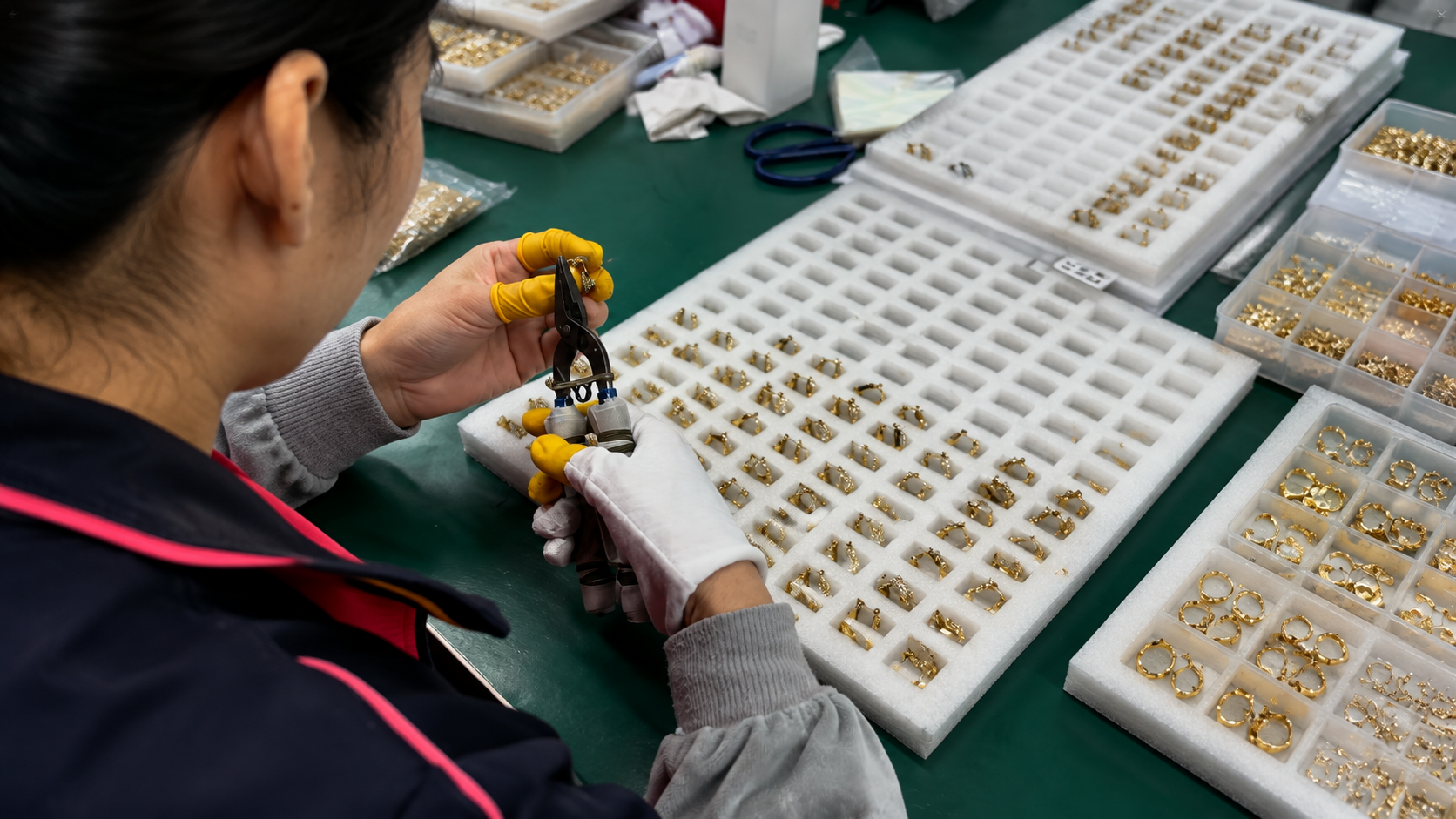
Create a Written Sample Approval Record
Once the sample is approved, retain a reference sample and document the specifications that determine product acceptance.
The approval record should include:
- Product reference number and approved design.
- Material grade and specified surface finish.
- Dimensions, weight requirements, and component details.
- Approved photographs and sample version.
- Agreed appearance and functional inspection criteria.
- Packaging requirements and applicable testing requirements.
The approved sample should serve as the reference for subsequent production inspections. Changes to the design, material, coating, or components should be documented and approved before implementation.
Planning a bulk earring order? Share your product references, target quantities, and inspection requirements with your supplier before confirming production. Touchlove Jewelry can discuss sample arrangements and applicable quality-control requirements for selected designs.
4. Compare Wholesale Earring Quotes Fairly
The lowest unit price does not necessarily represent the best sourcing option. Buyers should compare quotations based on equivalent specifications, order quantities, packaging requirements, and delivery arrangements.
Compare Equivalent Specifications
Provide the same product information to each supplier when requesting quotations.
Comparison Item Information to Confirm Product design Reference number, drawings, or approved images Material Stainless steel grade and additional materials Surface finish Color, coating process, and surface appearance Dimensions Length, width, thickness, and relevant tolerances Components Posts, backings, hinges, clasps, and decorative elements Order quantity Quantity per design and total order quantity Packaging Individual bags, jewelry cards, boxes, labels, and branding Quality requirements Sample approval and agreed inspection criteria Lead time Estimated sampling, production, and dispatch schedule Shipping Destination, shipping method, and applicable shipping terms A standardized comparison makes it easier to identify whether price differences reflect product specifications, production requirements, or commercial terms.
Understand MOQ and Custom Jewelry Tooling
MOQ (minimum order quantity) varies by supplier, product design, customization level, material requirements, and production arrangements.
Existing designs may have different ordering conditions from products requiring new tooling, custom components, or specialized packaging. Buyers should confirm whether MOQ applies per design, finish, color, or total order.
For customized products, custom jewelry tooling may involve additional development or tooling charges, depending on the design and manufacturing method. The supplier should clarify whether these charges are one-time costs or recurring production costs.
Wholesale pricing can also be influenced by product weight, manufacturing complexity, finishing, stone setting, assembly, packaging, and total order volume.
Evaluate the Total Cost of Sourcing
A sourcing decision should account for more than the quoted unit price. Buyers should consider sample development, packaging, inspection, freight, import-related costs, and the potential cost of defects or delayed deliveries.
Confirm payment terms, sample charges, production lead time, and any additional fees in writing before placing the order.
5. Prepare Specifications for Bulk Production and Repeat Orders
After selecting a supplier, the next priority is converting the approved design into a clear production specification. Incomplete instructions can cause misunderstandings about dimensions, finish, components, packaging, and acceptable quality variations.
Confirm the Production Specification
Before production begins, confirm that both parties are working from the same product requirements. The specification should identify the approved design, material grade, dimensions, surface finish, component construction, packaging, order quantity, and agreed inspection criteria.
For customized projects, buyers should also confirm which drawings, reference images, or samples constitute the approved version. Any requested changes should be documented rather than communicated only through informal messages.
Establish Quality Control Requirements
Quality control should address critical product characteristics, not just general appearance. Depending on the design, inspections may include dimensional checks, appearance inspection, clasp operation, post and backing compatibility, stone-setting condition, coating appearance, and packaging accuracy.
The buyer and supplier should agree on the applicable inspection method, sampling approach, defect classifications, and acceptance criteria before production.
Where market compliance testing is required, confirm the applicable requirements, relevant product samples, and available documentation before shipment. A test report applies to the samples and conditions identified in that report; it should not automatically be interpreted as proof that every product or production batch has been tested.
Maintain Consistency Across Repeat Orders
Repeat orders are easier to manage when approved specifications and reference samples are retained. For subsequent orders, confirm whether the material, surface finish, components, packaging, or manufacturing process has changed. Buyers should request approval before accepting changes that could affect product appearance or performance.
Keeping records of product references, approved samples, inspection results, and previous order specifications also helps businesses identify recurring issues and manage their product collections more efficiently.
6. Questions to Ask a Stainless Steel Earring Supplier
Before committing to a wholesale order, buyers should ask practical questions that clarify the supplier's capabilities and working arrangements.
Product and Material Questions
- Which stainless steel grades are available for the selected design?
- Can the supplier confirm material and surface-finish specifications?
- Are the posts, backings, hinges, and other components included in the quotation?
- Can relevant material or test documentation be provided where required?
Sampling and Customization Questions
- Can the supplier provide a sample before bulk production?
- What information is required to develop a customized earring?
- Can dimensions, finishes, decorative elements, or branding be adjusted?
- How are sample revisions and final approvals documented?
Production and Quality Questions
- What is the MOQ for existing designs and customized products?
- What is the estimated sampling and production lead time for the specific order?
- Which inspection steps are performed, and what criteria are used to evaluate finished products?
- How are defects, approved changes, and repeat-order requirements managed?
Packaging and Export Questions
- Which standard and customized packaging options are available?
- Can the supplier support jewelry cards, product labels, logo application, and branded packaging?
- Which shipping arrangements and export documents can be supported?
- What information is needed to calculate the quotation and delivery estimate?
A supplier's suitability depends not only on the available product range, but also on whether its manufacturing, quality, communication, and order-management processes match the buyer's requirements.
7. Wholesale Stainless Steel Earrings from Touchlove Jewelry
Touchlove Jewelry is the export brand of Guangzhou Likeme Jewelry Company Ltd, which has specialized in stainless steel jewelry since 2014.
The company's office and showroom are located in Guangzhou, Guangdong, China, while its production facility is located in Dongguan, Guangdong. The business supports B2B customers through product sourcing, manufacturing coordination, and OEM and ODM projects.
The Dongguan production facility has a stated monthly production capacity of up to 1,000,000 pieces, depending on product mix and production requirements. Touchlove Jewelry serves B2B customers across more than 40 countries and regions worldwide.
Its product range includes rings, necklaces, earrings, bracelets, bangles, and jewelry sets. For earring buyers, available sourcing options may include hoops, studs, huggies, drop earrings, and other fashion designs.
OEM and ODM Earring Development
For existing designs, buyers can provide product references, required quantities, preferred finishes, and packaging requirements when requesting a quotation.
For customized projects, an OEM jewelry manufacturer may need design drawings, reference images, dimensions, material specifications, target quantities, and branding requirements to assess feasibility and production needs.
Touchlove Jewelry supports OEM and ODM projects, including selected design development and customization according to project requirements. Available options, MOQ, development costs, and lead time should be confirmed for each project. Learn more about Touchlove Jewelry OEM and ODM services for customized jewelry development and private-label requirements.
Quality and Compliance Documentation
Buyers should identify the relevant material, chemical, and product requirements for their intended markets before placing an order. Touchlove Jewelry has documentation covering lead and cadmium testing and nickel-release testing for identified samples. Buyers should confirm the applicable report, tested product, reference standard, and report scope for their specific requirements.
Testing documentation should be interpreted according to the samples and conditions identified in the relevant reports. It should not be used to make unsupported claims that every product is universally compliant or suitable for every wearer.
Request a Wholesale Earring Quote
To discuss wholesale stainless steel earrings, prepare the following information:
- Product references or design images.
- Target quantities per design.
- Preferred material and surface finish.
- Required dimensions and component specifications.
- Branding and packaging requirements.
- Target delivery date and shipping destination.
Ready to develop your next earring collection? Contact Touchlove Jewelry to discuss wholesale sourcing, product specifications, and customized design requirements. Providing clear product references and target quantities helps the team assess the project and prepare a more relevant quotation.
Frequently Asked Questions About Wholesale Stainless Steel Earrings
What should buyers check before purchasing wholesale stainless steel earrings?
Buyers should confirm material grade, surface finish, dimensions, post and backing compatibility, clasp function, appearance consistency, packaging requirements, MOQ, and delivery terms. Sample approval and agreed quality inspection criteria should be established before bulk production.
Is 316L stainless steel always better than 304 stainless steel for earrings?
Not necessarily. Both grades have different properties and may suit different applications. 316L is commonly selected when improved corrosion resistance is a priority, while the appropriate grade depends on product design, intended use, required specifications, and project budget.
What affects the MOQ for wholesale earrings?
MOQ depends on the supplier's ordering policy, whether the product is an existing style or a customized design, material and component requirements, tooling needs, surface finishing, and packaging specifications. Buyers should confirm whether the minimum applies per design, finish, color, or total order.
Can stainless steel earrings be customized for a private-label brand?
Customization may include dimensions, surface finishes, selected decorative elements, logo application, jewelry cards, and retail packaging. Available options depend on product design, manufacturing requirements, order quantity, and supplier capabilities. Buyers should confirm feasibility, costs, MOQ, and lead time before approving a project.
How can buyers reduce quality problems in bulk earring orders?
Buyers can reduce risk by providing complete specifications, approving a reference sample, documenting critical product requirements, agreeing on inspection criteria, and confirming packaging and shipping arrangements. Changes to the approved design or specifications should be documented and authorized before production.
Looking for a Stainless Steel Earring Supplier?
Contact Touchlove Jewelry for wholesale stainless steel earrings, OEM/ODM development, and private-label inquiries.
Email: info@touchlove-jewelry.com
WhatsApp: +86 15918528597

About Touchlove Jewelry
Guangzhou Likeme Jewelry Company Ltd, the manufacturer behind Touchlove Jewelry, has specialized in stainless steel jewelry since 2014. With an office and showroom in Guangzhou and a production facility in Dongguan, China, we provide OEM/ODM manufacturing and wholesale jewelry solutions for brands, wholesalers, distributors, and retailers worldwide, with a monthly production capacity of up to 1,000,000 pieces.
Learn More About Touchlove Jewelry →-

Showroom Address: Unit 1607 RCC Huwanli, No. 11-13 Tianxin 2nd street, Baiyun District, Guangzhou
Factory Address: 4th Floor, Hongye Zhong Road, No 4th, Changan town, Dongguan, China
Phone: +86 15918528597
Email: info@touchlove-jewelry.com
- Company Info
- About Us
- OEM & ODM
- Contact Us
- Jewelry Test Reports
- Downloads
- FAQ
- Blog
- Payment & Shipping
- Customs & Taxes
- Locations We Ship To
- Shipping Policy
- Payment Methods
Copyright © Guangzhou Likeme Jewelry Company Ltd. All Rights Reserved.

- NEW
